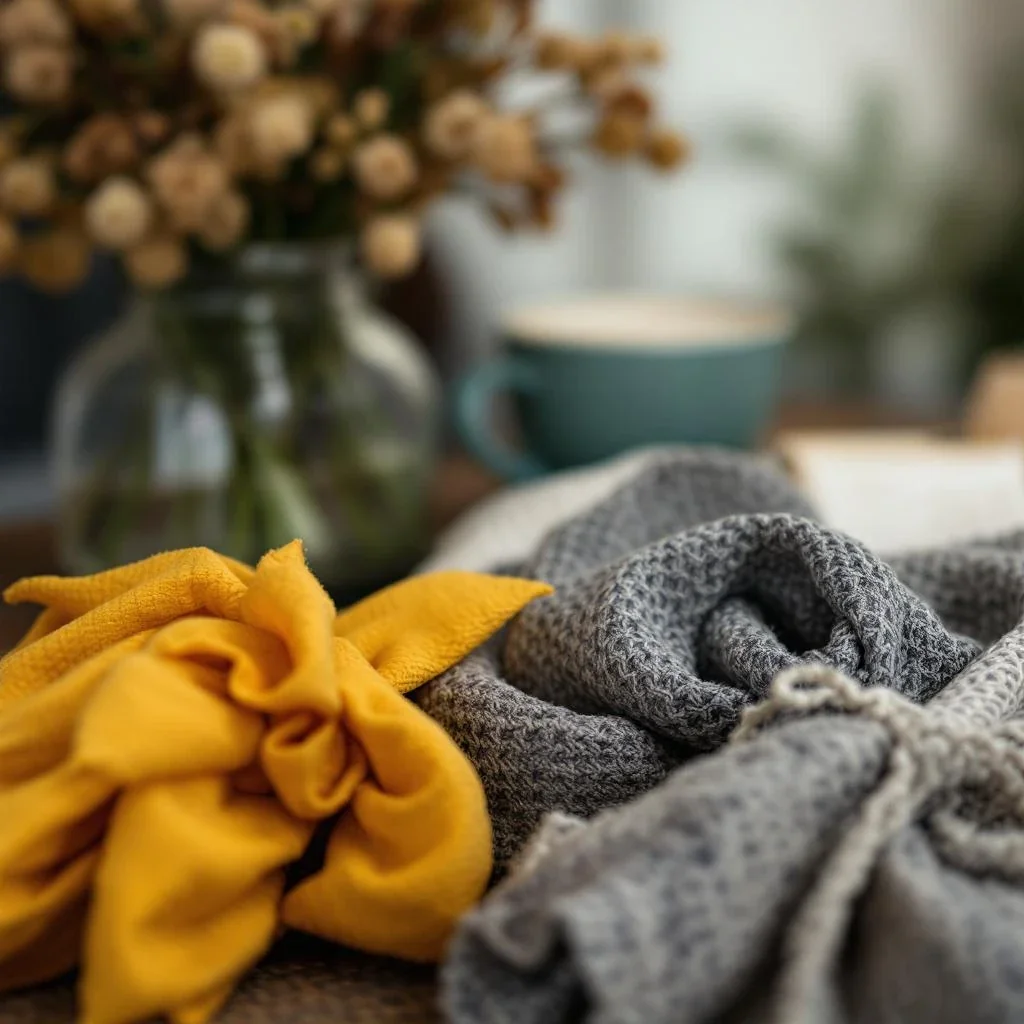
There’s a reason you pause when you pick up a hand-thrown ceramic mug, why your fingers trace the slight unevenness of a hand-stitched cushion, why a carved wooden bowl on your kitchen counter feels like it belongs there in a way a factory-made equivalent never could. That response isn’t sentimental weakness — it’s deeply wired into your neurology, your psychology, and arguably your humanity. Understanding why handmade objects move us so profoundly is the first step toward creating a home that doesn’t just look beautiful, but genuinely supports your inner calm.
Object Attachment Theory: Why We Bond With Things That Bear a Human Trace
Psychologists have long studied what’s known as object attachment — the emotional bonds we form with physical possessions. Research indicates that this attachment intensifies significantly when an object carries visible signs of human involvement. A slight asymmetry in a hand-forged door handle, the tool marks on a ceramic vase, the natural variation in a hand-woven textile — these are not flaws. They are signatures of presence.
Studies from the Journal of Consumer Psychology show that when people know an object was made by hand, they perceive it as literally containing more “love.” This isn’t metaphor — participants consistently assigned higher emotional value, reported greater satisfaction, and were more reluctant to part with handmade items than identical machine-made alternatives. The reason? Our brains interpret traces of human effort as a form of social connection. Owning a handmade object is, on a neurological level, a quiet form of relationship.
For women who are consciously curating their living spaces as extensions of their mental wellbeing, this insight is transformative. Every artisanal detail you invite into your home becomes a subtle anchor of human warmth — a counterweight to the sterile perfection of mass production that, studies suggest, can actually increase feelings of alienation.
Wabi-Sabi: Finding Peace in the Perfectly Imperfect
The Japanese philosophy of wabi-sabi offers a profound framework for understanding why handmade objects promote calm. At its core, wabi-sabi celebrates transience, imperfection, and incompleteness — the cracked glaze, the uneven edge, the patina that deepens with age. Rather than triggering anxiety (as imperfection does in perfectionist design cultures), these qualities invite acceptance.
When your living room contains objects that embrace natural irregularity, your nervous system receives a subtle but powerful message: things don’t need to be perfect to be whole. This is particularly relevant when you understand how your spatial environment directly influences your nervous system — the objects within a room are not mere decoration but active participants in your physiological state.
Integrating wabi-sabi into your home isn’t about creating a curated “aesthetic.” It’s about allowing your space to breathe, to age, to carry story. A linen curtain that softens with every wash. A wooden table that develops its own geography of use. These are not signs of neglect — they are evidence of a life well-lived.
Belgian Artisans Speak: The Invisible Thread Between Maker and Home
Belgium has a rich yet often understated tradition of craft. Speaking with artisans across Flanders and Wallonia reveals a shared philosophy: the maker’s intention lives inside the object.
Ceramicist Anne-Claire Delcourt from Ghent describes her process as “a conversation between my hands and the clay — what emerges carries the energy of that exchange.” Woodworker Pieter Vanhoorne, based near Bruges, explains that he deliberately leaves subtle tool marks in his furniture: “When someone runs their hand along the surface, they’re touching a moment of my attention. That connection is real.”
This perspective aligns with research on embodied cognition — the idea that our understanding of the world is shaped through physical, sensory interaction. When you touch an artisanal object, your brain doesn’t just register “wood” or “clay.” It registers intention, care, and time. Knowing how natural materials influence your emotional state adds another dimension: the material itself carries calming properties that synthetic alternatives simply cannot replicate.
Your Brain Knows the Difference: The Neuroscience of Touch
Perhaps the most compelling evidence comes from neuroscience. Studies using fMRI imaging show that touching handmade objects activates different brain regions than touching machine-made equivalents. Handmade textures — with their organic irregularities — stimulate the somatosensory cortex more richly, while simultaneously activating areas associated with emotional processing and reward.
Machine-made surfaces, by contrast, tend to produce a flatter neurological response. They are efficient to process — the brain categorises them quickly and moves on. Handmade surfaces invite lingering, curiosity, and a micro-moment of mindfulness. In a world that constantly demands your attention, these micro-moments are not trivial. They are restorative.
A Practical Checklist: Recognising and Integrating Artisanal Details
Ready to bring more craft consciousness into your home? Here’s a step-by-step guide:
- Look for maker’s marks. Slight irregularities, tool impressions, or natural material variations are signs of handwork. Hold the object — does it feel alive under your fingers?
- Ask about origin. A true artisan can tell you about their process, materials, and intention. If a seller can’t answer these questions, the piece likely isn’t genuinely handmade.
- Start with daily-touch objects. Your coffee mug, door handles, the throw on your sofa — these are the items you interact with most. Prioritise craft here for maximum sensory benefit.
- Choose natural materials. Wood, clay, linen, stone, and wool respond to use and age gracefully. Synthetics remain static and emotionally inert.
- Embrace patina. Resist the urge to replace objects that show signs of age. Instead, reframe wear as a living record — your wabi-sabi practice begins here.
- Support local makers. Visit Belgian craft markets, open ateliers, and small studios. The story behind the object deepens your attachment to it.
Key Takeaways
- Handmade objects activate deeper emotional and neurological responses than mass-produced alternatives — this is science, not sentiment.
- Object attachment theory explains why artisanal pieces feel like they belong — they carry traces of human presence that your brain interprets as connection.
- The philosophy of wabi-sabi transforms imperfection from a source of anxiety into a source of peace and acceptance.
- Prioritise craft in the objects you touch most frequently — this is where the sensory and emotional return is highest.
- Building a home with artisanal integrity is not a trend. It is a deliberate, sustained practice of aligning your space with your deepest values.
Your home doesn’t need more things. It needs things that mean more. And in every hand-shaped curve, every natural imperfection, every surface that carries the quiet evidence of a maker’s care — that meaning is already waiting for you.